Phone: (IN) +91 80035 33335 (USA) +1 720 800 8859 Email: info@bimpactdesigns.com

Phone: (USA) +1 91733 86649, (IN) +91 80035 33335 Email: info@bimpactdesigns.comAssociate company of Dhanuka Group Venture – Since 2002
Phone: (IN) +91 80035 33335 (USA) +1 720 800 8859 Email: info@bimpactdesigns.com
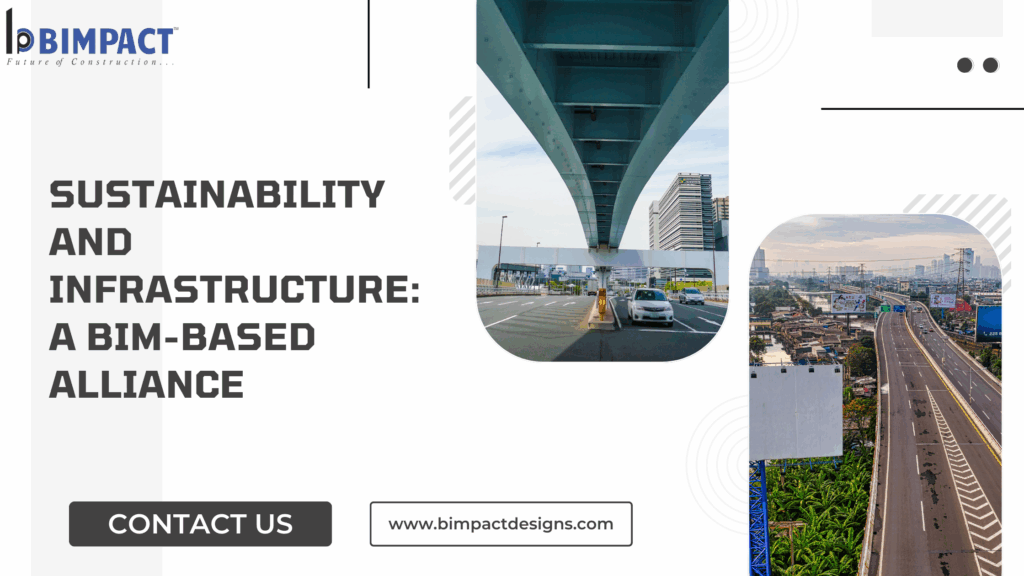
In an era where climate resilience and environmental responsibility are no longer optional, the construction industry is undergoing a fundamental transformation. Governments, investors, and communities are demanding greener infrastructure—projects that minimize carbon, optimize resources, and deliver long-term value. At the heart of this shift lies one powerful enabler: Building Information Modeling (BIM).
Today, BIM is not just a digital tool for design and coordination—it has evolved into a strategic ally for sustainable development. By integrating data, workflows, and intelligence across a project’s lifecycle, BIM strengthens the connection between sustainability and infrastructure, creating buildings and public assets that perform better, last longer, and impact the planet less.
Infrastructure—bridges, highways, transit stations, utilities, public buildings—forms the backbone of modern life. Yet, it also accounts for significant carbon emissions, material waste, and operational inefficiencies.
Key challenges include:
Sustainability isn’t just a trend. It’s a requirement for global competitiveness and regulatory compliance.
BIM enhances sustainability by enabling better planning, analysis, and decision-making—long before construction begins and long after operations start.
BIM provides precise quantification, eliminating over-ordering and minimizing on-site waste. Clash detection prevents rework, reducing time, cost, and environmental impact.
With BIM-integrated energy simulation tools, teams can analyze daylighting, HVAC loads, thermal performance, renewable energy potential, and more.
This leads to energy-efficient designs that slash operational carbon.
BIM supports embodied carbon assessments by linking materials and quantities to databases like EC3. This helps teams compare alternatives and select low-impact options.
Through digital analysis, BIM enables the design of water-saving systems, rainwater harvesting layouts, and sustainable drainage systems.
4D and 5D BIM help optimize construction sequencing, logistics, and site planning—resulting in less fuel use, reduced labor inefficiencies, and improved safety.
Once built, BIM acts as a digital twin, enabling:
Cities and governments implementing BIM-driven sustainable infrastructure are experiencing tangible benefits:
BIM turns sustainability from a vague aspiration into measurable, trackable outcomes.
As countries commit to green infrastructure and net-zero goals, BIM will serve as the backbone of these transformations. With advancements in digital twins, AI-driven design, IoT integration, and cloud workflows, the BIM-sustainability alliance will only grow stronger.
A future where cities operate with fewer emissions, buildings generate their own energy, and construction minimizes impact on the planet becomes achievable—with BIM leading the way.
Sustainable infrastructure is no longer a futuristic concept—it’s a necessity. BIM empowers project teams to build smarter, faster, and greener by connecting design intelligence with environmental responsibility.
The alliance is clear: BIM is the pathway to sustainable, resilient, and future-ready infrastructure.