Phone: (IN) +91 80035 33335 (USA) +1 720 800 8859 Email: info@bimpactdesigns.com

Phone: (USA) +1 91733 86649, (IN) +91 80035 33335 Email: info@bimpactdesigns.comAssociate company of Dhanuka Group Venture – Since 2002
Phone: (IN) +91 80035 33335 (USA) +1 720 800 8859 Email: info@bimpactdesigns.com
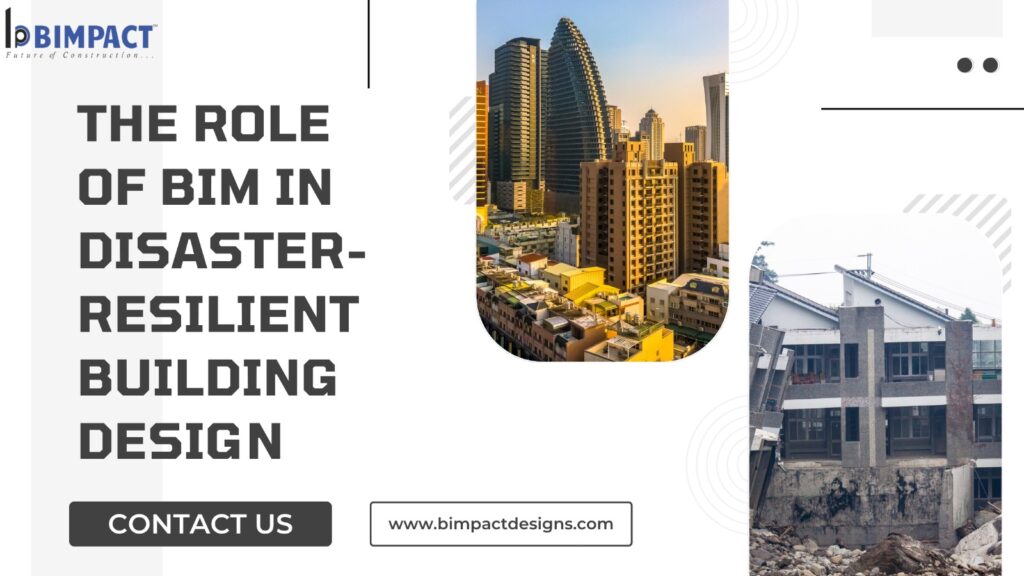
In an era marked by increasing natural disasters, rising sea levels, intense storms, wildfires, and earthquakes, the need for resilient infrastructure has never been more urgent. Building Information Modeling (BIM) has emerged as a transformative tool in designing buildings that can withstand these challenges, enabling professionals to plan, design, and manage buildings with disaster resilience at the forefront.
BIM, or Building Information Modeling, is a digital process that allows architects, engineers, and construction professionals to collaborate on a building project using a shared 3D model. It integrates structural, architectural, mechanical, and environmental data into a single intelligent model, allowing for better decision-making throughout the building’s life cycle.
1. Risk Analysis and Simulation
BIM enables designers to simulate various disaster scenarios—such as floods, earthquakes, and high winds—during the early stages of a project. These simulations help identify vulnerabilities in a building’s design and provide insights into how the structure will respond under stress.
2. Improved Structural Design
By integrating geospatial and environmental data, BIM supports more informed structural engineering decisions. Designers can adjust the building form, materials, and systems to meet resilience standards and local building codes, ensuring the structure can resist specific hazards.
3. Efficient Emergency Planning
BIM allows for detailed modeling of evacuation routes, emergency exits, and fire suppression systems. This facilitates better preparedness and safety planning, especially for high-occupancy buildings like hospitals, schools, and commercial complexes.
4. Lifecycle Management and Maintenance
Resilience does not stop at design. BIM supports the entire lifecycle of a building, offering facility managers data on materials, maintenance schedules, and repair history. It is essential for post-disaster recovery and long-term durability.
5. Collaboration and Communication
With BIM, stakeholders, engineers, architects, city planners, and emergency response teams can all work from the same data-rich model. This collaborative environment ensures alignment across all teams, reducing the risk of oversight and enhancing the resilience of the final structure.
Several cities and governments are now adopting BIM as part of their resilience strategies. For example, post-earthquake reconstruction efforts in Japan and Italy have relied heavily on BIM to redesign infrastructure with improved resistance to seismic activity. Similarly, flood-prone areas are using BIM models to evaluate water flow and plan buildings accordingly.
As climate risks continue to rise, BIM will play an increasingly critical role in sustainable and disaster-resilient design. It is not just a tool for construction—it is a comprehensive strategy for survival, sustainability, and safety.
Investing in BIM today means designing for a safer tomorrow.